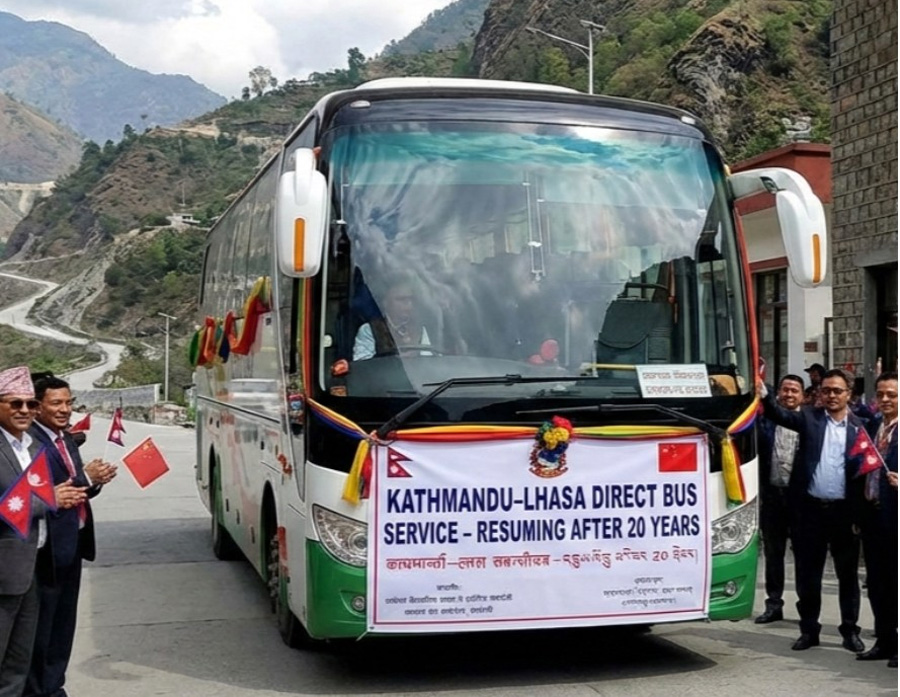
The long-awaited Kathmandu–Lhasa bus service is set to resume after an agreement reached during the Nepal–China Joint Meeting of Commerce Secretaries held in Lhasa on January 20–21. The decision is expected to significantly enhance cross-border trade, tourism, and people-to-people connectivity between Nepal and China.
According to the Ministry of Industry, Commerce and Supplies, the official launch date of the direct bus service will be finalized through diplomatic channels. Nepali Consul General in Lhasa, Laxmi Prasad Niraula, confirmed that both sides have agreed in principle to restart the service, which had briefly operated nearly two decades ago.
“The Kathmandu–Lhasa bus service was suspended within two months of operation due to road challenges and complex visa procedures. This time, efforts will be made to simplify the visa process and address operational issues,” Niraula said. The earlier service was operated by Sajha Yatayat.
The total distance between Kathmandu and Lhasa is approximately 1,000 kilometers, with the route passing through Tatopani border point. Once operational, buses are expected to complete the journey in 20 to 22 hours. While the Tatopani–Lhasa section is considered reliable, concerns remain regarding road conditions on the Kathmandu–Tatopani stretch, particularly for large buses.
The resumption of the Kathmandu–Lhasa bus service is expected to strengthen bilateral trade, tourism flows, and regional connectivity, offering an affordable and scenic overland travel option between Nepal and China’s Xizang Autonomous Region.
The Nepali delegation to the meeting was led by Commerce Secretary Dr. Ram Prasad Ghimire, while the Chinese delegation was headed by Chatro Peh, Vice Chairman of the People’s Government of the Xizang Autonomous Region. The meeting reviewed progress on agreements made during the previous session held in Kathmandu in November 2024 and discussed broader cooperation on trade, investment, transit facilitation, and infrastructure development.
According to ministry spokesperson Netra Subedi, discussions included updating the 1981 Trade and Payment Agreement, simplifying border entry passes for traders and transport workers, expediting the Tokha–Chhahare tunnel project, fixing fertilizer quotas, and continuing China’s zero-tariff policy for Nepali goods even after Nepal graduates from least developed country status.
Both sides also agreed to improve customs and border management by implementing the Nepal–China Border Transport Agreement, promoting green channels with risk-based inspections, easing vehicle movement, strengthening laboratory testing, exchanging trade data, and facilitating Nepal’s jute exports.
Infrastructure cooperation featured prominently, with agreements to build roads and a friendship bridge connecting Kimathanka (Nepal) with Chen Tang (China), continue construction of the Inland Container Depot (ICD) at Timure, simplify customs procedures at the Korala border point, and accelerate road construction projects including Rasuwa–Syaphrubesi and Hilsa–Simikot.
Talks were also held on establishing a sister city relationship between Gyirong and a municipality in Rasuwa district, and advancing the Nepal–China high-technology agriculture park project.
Both delegations described the meeting as positive and forward-looking, agreeing that the fourth Nepal–China Commerce Secretaries’ Meeting will be held in Nepal in 2027.