As spring settles over the Kathmandu Valley, the city’s ancient courtyards and narrow streets begin to come alive with rhythmic energy. The festival of Paachahre arrives not just as a ritual observance but as a vibrant expression of Newa identity, where community spirit, spirituality, and cultural memory blend into a colourful celebration.
Paachahre, deeply rooted in the traditions of the Newa community, is more than a festival, it is an invitation to gather and reconnect. The name comes from the Nepal Bhasa word “Paa,” meaning “to call” or “to invite.” Unlike the more intimate household festivals known as chakha, Paachahre belongs to the nakha tradition, which encourages social interaction and community participation.
Friends, relatives, and neighbours are welcomed into homes where shared meals become meaningful rituals of connection. In this way, Paachahre transforms private spaces into communal ones, reinforcing the importance of togetherness in a rapidly modernising city like Kathmandu.
Spiritual Significance of Paachahre
At the heart of the festival lies a profound spiritual dimension shaped by tantric beliefs. Paachahre is observed during Krishna Chaturdashi, the 14th day of the waning moon, which fell on March 17 this year. Traditionally, this period is believed to be a time when unseen cosmic forces grow stronger.
Rather than evoking fear, Paachahre channels this belief into devotion and ritual practice. Through offerings, night-long worship, and symbolic ceremonies, devotees seek protection, prosperity, and well-being. The festival represents a cultural response to cosmic uncertainty, blending faith seamlessly into everyday life.
One of the most fascinating aspects of Paachahre is the worship of Luku Mahadya, a hidden and mysterious form of Lord Shiva. Unlike the widely revered ascetic image of Shiva, Luku Mahadya reflects a more secretive and human-like narrative. Women of the Newa community offer meat, alcohol, and seasonal foods – rituals that may seem unconventional but reflect deep layers of mythology and symbolic meaning.
These traditions are often linked to legends involving Bhasmasur, the strength of Bhimsen, and the divine relationship between Shiva and Parvati. Through these stories, Luku Mahadya represents the imperfect yet relatable dimensions of divinity.
Traditional Food and Cultural Heritage
Food and drink play a vital role during Paachahre. Traditional delicacies such as samay baji, along with homemade beverages like aila and tho, are carefully prepared and shared.
These are not merely festive treats but important markers of Newa heritage. The act of preparing and enjoying these foods together strengthens family bonds and preserves culinary traditions passed down through generations.
The Dya Lwakegu Jatra Procession
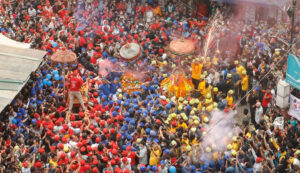
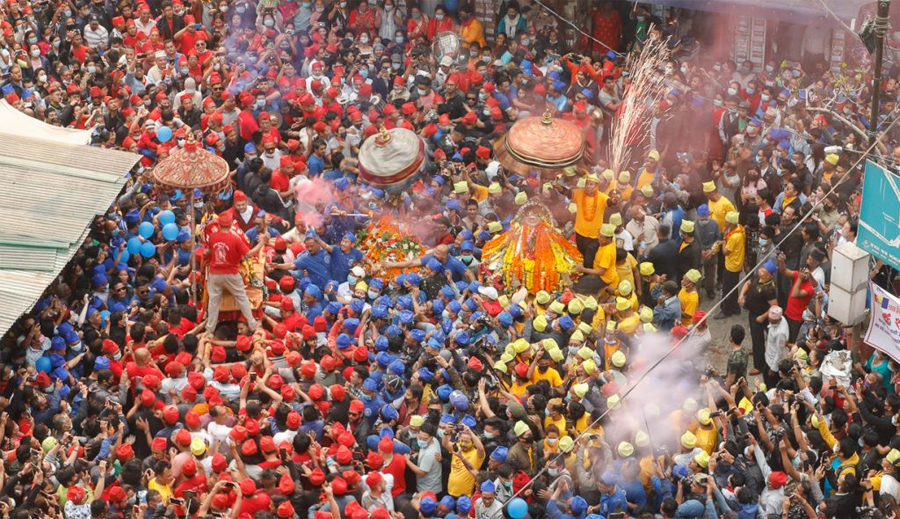
Beyond household rituals, Paachahre unfolds across the city through lively processions and public celebrations. The movement of Ajima deities, protective mother goddesses, through the streets creates a powerful visual spectacle.
One of the most significant events is the ceremonial gathering of three Ajimas — Kanga Ajima, Lumadhi Ajima, and Tebaha Ajima. Their meeting at Tundikhel and Ason is known as the Dya Lwakegu Jatra. This symbolic reunion of divine sisters emphasises unity rather than confrontation.
The circling of palanquins, torch exchanges, and synchronised rituals reflect a sacred cultural language preserved for centuries. These processions connect various neighbourhoods — from Tankeshwor to Naradevi, Kilagal to Tyangal — creating a spiritual network that binds the city together.
Conclusion: A Festival of Community and Continuity
In essence, Paachahre is a festival of many layers, social and spiritual, private and public, ancient yet evolving. It invites people to gather, remember traditions, and actively participate in a cultural continuum that has endured for generations.
From midnight rituals to shared feasts and vibrant street processions, Paachahre stands as a powerful reaffirmation of life, belief, and community in the heart of Kathmandu.